Post-Op Rehabilitation for Successful Sport Injury Outcomes
Surgery to repair a sports injury coming up? Learn how to support faster and more complete healing from the best orthopedic doctor in San Francisco.

Contents
Athletes who returned to sport within six months of orthopedic surgery faced a fivefold increase in re-injury risk compared to those who returned at eight or 12 months. This gap is driven almost entirely by the quality of rehabilitation prior to the return to sport. Post-op rehab is the phase most athletes underestimate. Rushing it, whether from outside pressure, incomplete information, or simply not understanding what a thorough recovery looks like, is among the most common reasons promising recoveries stop short.
Read on for evidence-based information on post-op rehabilitation at every stage, including managing pain and inflammation, rebuilding strength and control, recognizing the signs that you're ready to return to your sport safely, and where to find the best orthopedic specialist in San Francisco.
How Long Does Post-Op Rehab Take for Sports Injuries?
Recovery after orthopedic sports surgery is a little bit different for everyone, and understanding that early in the process can prevent some of the most costly mistakes made during healing. The first thing you should know is the average recovery time for common orthopedic surgeries:
An ACL reconstruction typically requires nine to 12 months of structured rehabilitation before a safe return to competitive sport
A rotator cuff repair often takes six to 12 months
A meniscus repair often ranges from four to six months, depending on the extent of the damage
Regardless of the surgery type, clinical research identifies three core rehabilitation phases:
A tissue protection phase focused on a range of motion and swelling control, lasting roughly four to eight weeks
A motor control phase that rebuilds strength and cardiovascular fitness through at least 16 weeks
A functional optimization phase that reintroduces running, jumping, and sport-specific movement before a return to competition
Each phase is governed by physical benchmarks the athlete must meet, not by a date on a calendar.
What to Expect in the First Weeks After Surgery
The first two weeks after orthopedic surgery are among the most important and the least understood. This is when the incision site is tender to the touch, and the joint is swollen and stiff. During this time, even simple movements feel like they require more effort than they should. This is why the focus during the first weeks of rehab is not on building strength but on three specific priorities: protecting the surgical repair, controlling inflammation, and slowing early muscle loss through careful, guided movement.
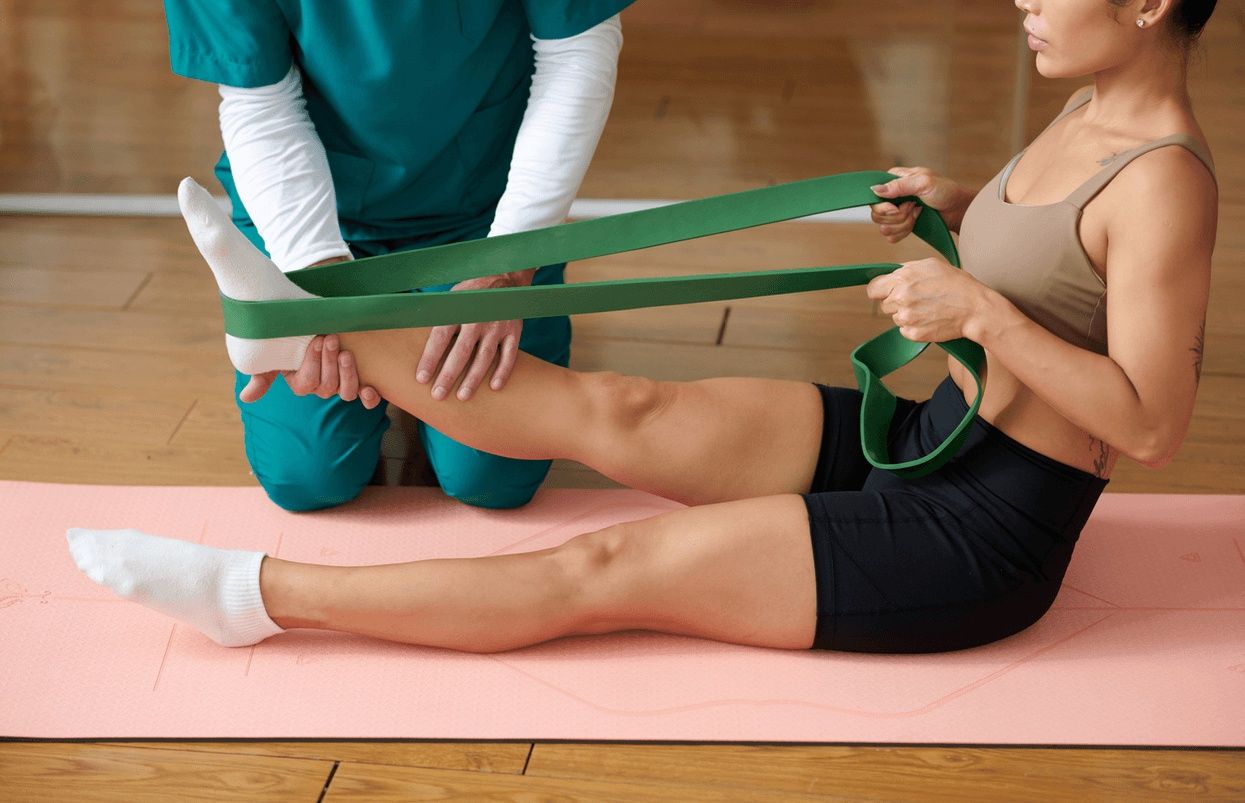
Early physical therapy has been shown to be vital for preventing complications such as blood clots, deep vein thrombosis, and muscle atrophy. A physical therapist will guide weight-bearing restrictions, prescribe light range-of-motion exercises, and monitor swelling throughout the initial healing window.
The Most Effective Physical Therapy Exercises After Sports Injury Surgery
Physical therapy after surgery depends on the type of surgery, the condition of the surrounding tissue, and the phase of recovery. What a soccer player rehabbing an ACL reconstruction needs at 12 weeks differs from what a swimmer rehabbing a rotator cuff repair needs at the same point.
As rehabilitation advances, the best orthopedic surgeon in San Francisco and physical therapists track progress using objective measures rather than pain levels alone. The limb symmetry index, which measures the strength or performance output of the recovering limb as a percentage compared to the healthy one, is one of the most widely used markers in return-to-sport decision-making.
How to Avoid Setbacks and Re-Injury During Recovery
One of the most common setbacks is doing too much, too fast. When pain starts to fade, and the joint feels more stable, the natural response is to get back to doing what you love. The challenge is that the absence of pain is not a reliable indicator of tissue readiness. Ligaments and tendons heal through a gradual process in which the graft transforms into functional tissue over months. That process continues well after pain has resolved, and loading the joint too soon is a primary driver of re-injury.
How to Know You're Ready to Return to Sport
While physical therapy remains the foundation of post-operative recovery, for some athletes, orthobiologics provide an additional layer of support by harnessing the body’s natural healing mechanisms. The two most widely studied orthobiologic treatments in sports medicine are platelet-rich plasma (PRP) and bone marrow aspirate concentrate (BMAC). These orthobiologics are both derived from a patient’s own blood or bone marrow and are designed to enhance tissue repair by delivering concentrated growth factors, platelets, and regenerative cells directly to injured or surgically repaired areas.
Research has shown that PRP improves pain, tendon healing, and functional outcomes, while BMAC has been associated with lower revision surgery rates, improved function, and reduced pain in certain orthopedic conditions. Although orthobiologics are not a replacement for structured rehabilitation and are not appropriate for every patient, they may help create a more favorable healing environment during critical stages of recovery when used as part of a comprehensive treatment plan under the guidance of a sports medicine physician experienced in regenerative therapies.
Finding the Best Orthopedic Surgeon in San Francisco for Sports Injury Recovery
Dr. James Chen approaches post-operative care the same way he approaches surgery: with clinical precision, clear goals, and consistent communication at every stage. Dr. James Chen is a board-certified orthopedic surgeon with dual certification in both Orthopedic Surgery and the subspecialty of Orthopedic Sports Medicine.
As a fellowship-trained sports medicine and arthroscopy specialist at UCSF, he serves as an assistant clinical professor at the UCSF School of Medicine and as the Director of the San Francisco Sports Medicine Fellowship. His clinical focus is minimally invasive arthroscopic surgery of the knee, shoulder, elbow, hip, and ankle, an approach that reduces surgical trauma and shortens recovery compared to traditional open procedures.
Ready to get back to peak performance with the best orthopedic surgeon in San Francisco?